case study

White-label multi-tenant ordering platform

Hospitality technology startup

One codebase, a separately branded app per venue - building a white-label ordering platform from idea to launch

Multi-tenant platform·AI-Accelerated Product Engineering·Food Tech / SaaS·January 2024

Client identity and commercially sensitive detail are withheld under the confidentiality terms of this engagement.

Challenge

Challenge The food delivery market is dominated by a small number of marketplaces taking double-digit commission on every order. For a venue doing meaningful delivery volume, a large share of revenue leaves the business every month, to a platform that owns the customer relationship, the data, and the brand experience. The venue is a supplier; the platform is the business. Our client saw a structural alternative: instead of building another marketplace, build the infrastructure that lets every venue become its own. Its own branded iOS app, its own Android app, its own website, its own ordering system - owned outright, branded to the venue, with the customer relationship belonging to the venue. Price it as a flat monthly subscription, take no commission. The unit economics invert: the venue keeps what it earns, the customer downloads an app belonging to the venue, and the business earns subscription revenue rather than transaction fees. The technical challenge was substantial. Building one food delivery app is a large engineering effort. This model required a multi-tenant platform: a single architecture powering hundreds of independent, fully branded venue apps at once. Each tenant needed its own iOS and Android app in the respective stores, its own branded web ordering experience, its own menu management, driver app, loyalty program, push notifications, and delivery tracking. The platform behind all of it had to be configurable per venue, scalable across an unlimited number of tenants, and operable by an owner with no technical knowledge. They came to us with the idea, a clear market thesis, and a tight timeline - fast enough to validate the model before the window closed.

Approach

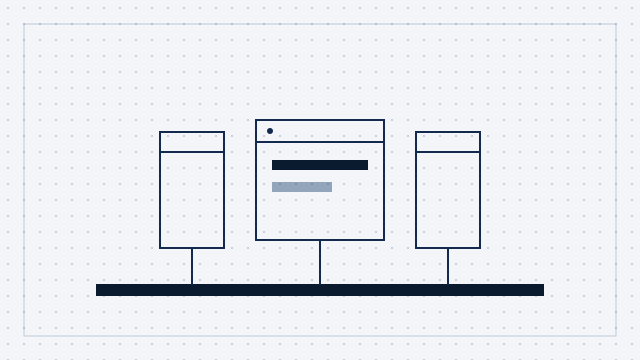
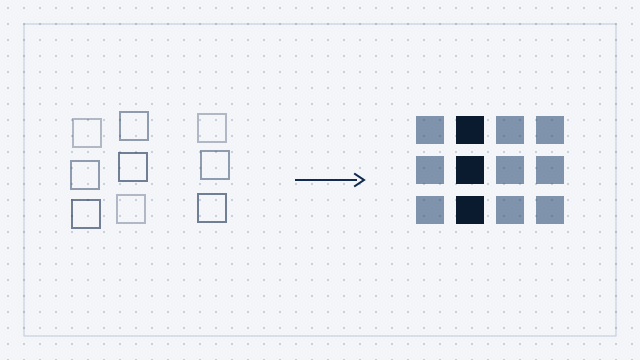
Approach We began with a scoping phase mapping the full product surface, defining the MVP, and making the architectural decisions that would determine everything downstream. The most consequential was the multi-tenancy model. There are two ways to build a multi-tenant mobile platform: a single app with tenant switching (one store listing, configured per venue at runtime), or a white-label model (a separate app per venue, built from a shared codebase and deployed individually). This product required the white-label approach - each venue needed its own listing, under its own name, with its own branding. That is a fundamentally different architecture from a single shared app. White-label meant building the core product as a configurable template: a single React Native codebase, shared across iOS and Android, accepting a tenant configuration at build time - brand colours, logo, app name, bundle identifier - and producing a deployable app specific to that venue. The backend had to be multi-tenant from day one, with every data model, API endpoint, and background job scoped to a tenant identifier. Shared infrastructure, isolated data. The MVP scope decision was disciplined: launch with what validates the core hypothesis - that a venue owner will pay a flat subscription for their own app instead of paying commission to a marketplace - and defer everything else. That meant the branded app on both platforms, menu management, online ordering with payment processing, basic delivery management, and the branded website. Driver app, loyalty, push notifications, and advanced promotions came after launch.

Solution

Solution We designed and built the full platform: Multi-tenant platform architecture - a backend built for white-label multi-tenancy from day one. Every venue is a tenant with isolated data, its own configuration, and its own branding. The platform supports an unlimited number of tenants on shared infrastructure, so the marginal cost of onboarding a venue is near zero. White-label iOS and Android apps - a single React Native codebase that builds into a fully branded, separately deployable native app per venue. Brand colours, logo, app name, store description, and bundle identifier configured per tenant. Each venue gets its own store listing, so customers download an app that looks and feels purpose-built for that venue, because architecturally it is. Menu management system - a venue-facing web dashboard for menus, categories, items, modifiers, pricing, availability, and images. Changes propagate to the app and website in real time. No technical knowledge required to operate it. Online ordering and payment processing - a full ordering flow integrated with a payment processor, order management for venue staff, order notifications, kitchen display integration, and order history and reporting. Branded web ordering - every venue gets a branded website with an embedded ordering experience, distinct from the app but built on the same menu data and ordering infrastructure, so customers who do not download the app can still order online. Delivery management - order assignment and delivery tracking, with a React Native driver app for delivery staff to receive and manage orders and real-time status pushed to customers. Loyalty and rewards - a points-based rewards system configurable per venue. Customers earn on orders and redeem against future ones, and the loyalty data stays with the venue rather than with a platform. Push notifications - venue-controlled notifications to their own customer base: promotions, new menu items, special offers, sent directly from the venue to the customers who downloaded their app. App store deployment pipeline - an automated pipeline for building and submitting white-label apps to both app stores on behalf of new tenants. What would otherwise be a manual, hours-long process per venue reduces to a configuration step.
Results

Results The platform launched as a live product, inverting the standard delivery economics for the venues that adopt it: a flat subscription instead of per-order commission, with the app, the customer relationship, and the data belonging to the venue. The multi-tenant architecture means new venues onboard without per-client engineering work, so the business scales commercially without scaling its engineering team proportionally. We took the product from founding idea to publicly available product. What this engagement demonstrates: we can make the architectural call that determines whether a business model works at all - here, white-label over shared-tenant - and then build the automation that makes the model economical to operate.

Technologies

React Native (iOS and Android, shared codebase)(Mobile)white-label multi-tenant architecture(Backend)Node.js (API layer)(Backend)PostgreSQL(Backend)payment processing integration(Backend)automated app store deployment pipeline(Infrastructure)real-time order management(Backend)push notifications (APNs + FCM)(Mobile)branded web ordering (Next.js)(Frontend)driver app (React Native)(Mobile)loyalty and rewards engine(Backend)venue management dashboard (React)(Frontend)

Ready to reach escape velocity?

Let's talk about your product.

Contact us